Tuesday, December 5, 2023

Self-Portrait Final Project


The Beautiful Beauty


For this final project, I recreated some of Cindy Sherman's pictures and  I also add my own images. Cindy Sherman is an American photographer known for her self-portraits in which she transforms herself into different characters and explores themes of identity, gender and power. She is one of the most influential photographers of the 20th century. Cindy Sherman is an American artist who became famous in the 1980s for her groundbreaking photographic self-portraits. She uses makeup, costumes and props to create unique characters and situations that explore themes of identity and femininity. Her work has been exhibited in museums and galleries around the world. Sherman's art challenges traditional gender roles and stereotypes, creating images of women that are complex, multifaceted and ambiguous. By subverting traditional expectations, Sherman encourages viewers to question their own assumptions and consider new perspectives. Sherman's art is seen as a reflection of her own identity and allows viewers to explore the complexities of gender identity and roles. It is seen as a way to explore and express emotions, and many people find comfort in her work. Cindy Sherman's art is unique and thought-provoking. It forces viewers to question and re-examine their own assumptions about beauty, identity and gender roles. Her work also offers a unique and powerful form of expression that resonates with many people. Cindy Sherman's art is unique and thought-provoking. It forces viewers to question and re-examine their own assumptions about beauty, identity and gender roles. Her work also offers a unique and powerful form of expression that resonates with many people.

For creating this project,: I used filters instead of makeup, and then I took the pictures. After I was done taking the pictures I edited them, then I emailed the pictures to my Gmail by three and I downloaded them on my computer and copied them then pasted them on a blank Microsoft Word page and I printed them and finally, I glued them on a white paper. It took time to organize the way I wanted to glue the pictures. 

Quote 1: "She uses herself because it's simpler, she says. She can push herself harder than any model, and she can avoid small talk."

Response: Sherman's self-portraits are not intended to represent herself, but rather to explore the idea of identity and representation. By using herself as a role model, she can more easily explore different identities and roles, as well as challenge traditional ideas about beauty and femininity.

Quote 2: "There's this tendency by those powers that be to obfuscate meaning and to take power away from language by robbing it of its truth."

Response: By taking away the power of language, those in power are able to control the narrative and manipulate the public's perception of reality. This allows them to spread false information and keep people in the dark. Furthermore, those in power can manipulate people's understanding of the facts and make it more difficult to challenge their decisions.

Bless Danel-Final Project " To let go"


                                                     "To let go"-Bles'Son Daniel & his Ma


John Berger

"... that a way of seeing the world, which was ultimately determined by new attitudes to property and exchange, found its visual expression in the oil painting, and could not have found it in any other visual art form." (Chapt 5)

"Yet despite this, one has the impression that publicity images are continually passing us, like express trains on their way to some distant terminus." (Chapt 7)

Mirzeoff

"The mix of light and smoke combines to form what we might call a very modern form of beauty" (pg 224).

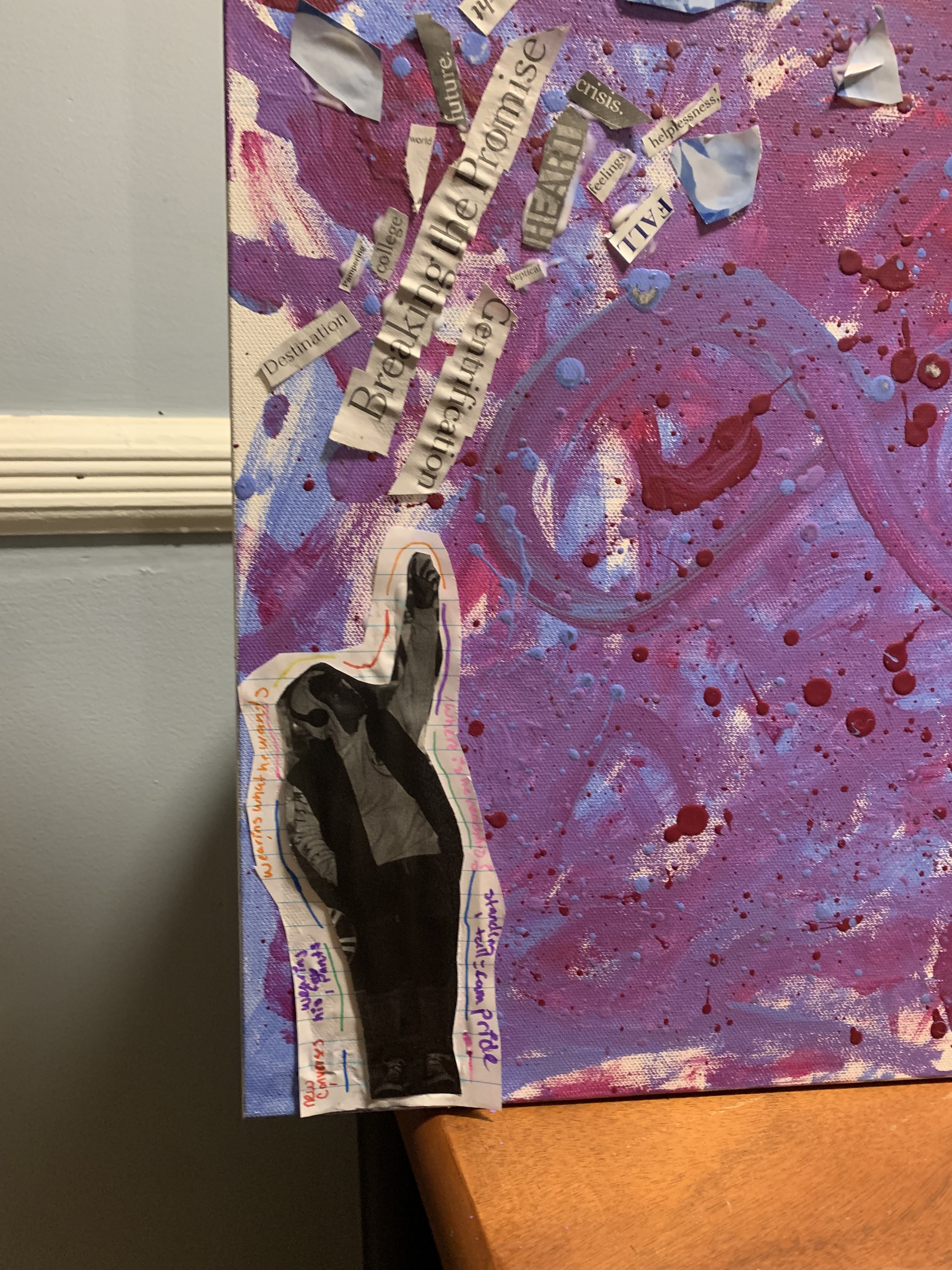
My final project for this classroom is named "To let Go" and was created to represent the black man and his burdens and how as time passes , he slowly let go of all the pain that has haunted him. My main inspiration for this art piece stemmed from Kehinde Wiley as I loved his expressive and colorful paintings. I wanted to replicate a similar style, having my mother and I use a mixture of blues, pinks and purples to make an aesthetic background. Only three colors were used as I wanted to keep the art piece minimalistic and easy to look at . I chose these colors as a way of representing space and the one being in the presence of the creator, being free and void of any conformity. Our bodies are only but a vessel but our energy and ideas are  infinite. I also chose these colors because I love them and I wanted to use colors that I love to express my message. As in the left corner of the art piece, there is an image of me in black and white raising my hand to the sky, reaching as well as letting go. The reaching of the hand is a symbol of strength in its entirety, symbolizing the strength of letting go and the strength of maintaining hope through tough times. I feel as though in this day and age, people are doing a great job in voicing their problems and opinions on matters that hurt them but they fail to realize the amount of strength it takes for them to go through such trials in the first place. People often think about letting go as a painful experience but often forget the beauty of the experience, forgetting that to fly, you need to let go and to ascend means to never let worldly affairs weigh you down. The collage portion of the piece is to symbolize all the things that would need to be let go. Even something as simple as words can be something we should let go, and although thoughts and ideas seem weightless, they still hold a good amount of weight and pain on our body, mind and soul. I like to think that the black and white image of myself is a great contrast to the beautiful spacey colors of the background. Once you live long enough in the world and move past childhood, life begins to seem meaningless and thus we all seem bleak and black white in the eyes of many. People in today's world have lost their sense of purpose due to social media and push for a faster and instantaneous lifestyle, so through the eyes of some including myself sees the world as a bland place. So many people try to  be like someone following trends without trying to be themselves. Just like in the John Berger readings, through this piece I wanted to showcase a different perspective of art, not reflecting on how the viewer may see the world but how the artist which I , myself views my own art showcasing my feelings and giving my thoughts on my own ideas. Like trains as mentioned by Berger, people will always find ways to pass you by , to only glance and look only for a second. If I were to make the most of those measly seconds, I would like to show myself in true form and give out what I can give into the world. I was never meant to be like anyone else but my own so I will always strive to be myself and be comfortable with myself. Furthermore, just like in the Mirzeoff quote, I wanted to bring a mixture of styles including Wendy Redstar’s annotation aesthetic as well as bring the abstract collage style of Wangeshi Mutu, sprinkled with a little Kehinde Wiley. From the beginning , I wanted to mimic the artwork of the artist we would learn about but make my own twist upon it . With this last and final project, I hope that I achieve my own piece of artwork that is very much inspired by those we have learned from but yet made into my own style of work with its own message.


Final Project "Gestalt"


Photos

Dimmness
Closer Yet

Initializing myself Soon

Bring Foward the Person

Layering the matrix self

Twist and move forward we dive

Inner is Outer, Now, Outer is Inner

Phantasm of futures yet known or been written 

Explanation

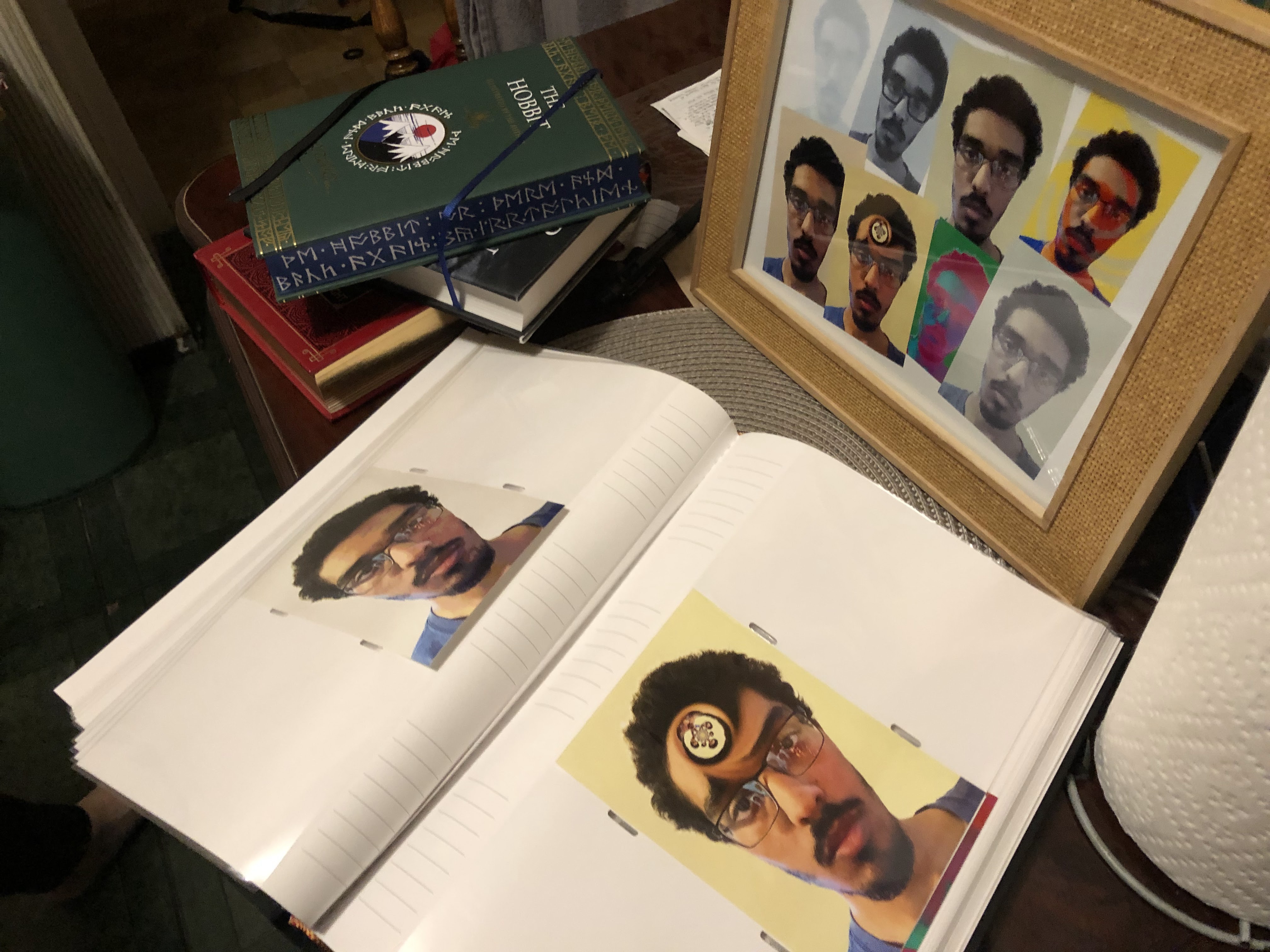
    This final project is an attempted summarisation of who I am as a person throughout my life in the form of 8 pictures. The project went through a couple of ideas of how I would conceptualize it. Many of these ideas were the idea of moving some object such as a paper figure or some clockwork mechanism. These were dropped due to a lack of practicability, time, and overall artistic skill. For the digital portion of the project, I began with a simple photo and tried to think of what I could do with it. The idea of time came to mind and how we associate the past as this blurry and at times black and white place far from our more colorful present. I took this conceptualization and merged it with my own understanding of who I thought I was early in my life.  

    The meaning of the project titled "Gestalt" (a German word) is a variety of things organized into one being and to be seen as more than the parts that make me up this being. In more simpler terms each part that makes me up can be looked at and viewed differently but once combined with others I am more than these parts. I am something new and unique with a new part adding to this greater whole. 

Project Description/process explained

    From this starting photo, I sought to bring forward towards the present I live in. I would desaturate the photo more for the past and add more color to it for the present. From there it was about stylizing the photos. What could I do to present myself in this moment of time? I experimented a lot with the photos to get the right feel. Each photo besides increasing in saturation also becomes less blurry and more in focus. I tried to incorporate this increased focus with each of the designs of the photos. Once past the halfway point in the photos I switched toward the metaphysical meaning of the unseen. I took a more unorthodox way of manipulating the photos to get across this point. 

    The physical project went through some designs. Until I decided upon the look of a place set you see in any house. Some corners are out in the open where a person leaves a scrapbook or photo album out amongst their collections of books. The photo book may be looked at at times but is never really paid attention to. The objects surrounding it are everyday objects you would see by a doorway entrance. Some books, keys, bits of paper. 

    Most interesting is how nearly everything in this spot of a house is never really touched or moved. It is displayed there proudly a thing to look at and glance at. Just as the way we experience who we are is this outward core of ourselves. All laid out there never really disturbed and yet if we just look and move some things around we can dive deeper into who we are. Each of the objects are bits of ourselves and the photo album is a catalog of who we are. Separately they are unique in their own way but together they are more. 

Some Insights

  Each photo acts as a step toward my understanding of myself. For most of the first 10-14 years of my life, I did not have a core understanding of myself. There was a personality, various interests, and a being. But no deep thoughts regarding who I am, what I am, and as to where I could go. There was a barrier, a barrier of shyness, introvertedness, fear, deep seated anxiety. I was on autopilot. Not until I went to high school did I begin to think of who I am. Gradually with the introduction of new people separate from my Grammer School where I spent many years with the same people did I begin to open. Slowly I came into my own the process most people do to become Adults a process that is always ongoing. High school helped to open this door of exploration. With college now nearing its end for me this place helped to further foster and encourage my growth as a person. Who I was 10 years ago is completely different and yet the same. For we never truly let go of our past selves but instead merge and grow with it adding to but almost never destroying these parts of ourselves. This quote from Bells Hook Patrichy encapsulates some of my life experiences. "Patriarchy as a system has denied males full access to full emotional well-being... To truly address male pain and male crisis we must as a nation be willing to expose the harsh reality that patriarchy has damaged men in the past and continues to damage them in the present." (Bell Hooks, pg 31).

This quote from Mirzoeff really connects with the ideas I talked about above regarding how I perceive myself and in general how others in turn perceive themselves percieving others. "Schechner claimed that all forms of human activity are a performance, assembled from other actions we have taken in the past to create a new whole. A performance might be an artwork, it might be a chef cooking a dish or a barber cutting hair. Or then again it might be anyone whatever giving a performance of their gender, race, and sexuality in everyday life." (How to See the World, pg 9)

Another quote that I feel semi-relates to my own personal experience in life and general journey "In the present moment of transformation, these categories of identity are being remade and reshaped. Today, claims queer theorist Jack Halberstam, “the building blocks of human identity imagined and cemented in the last century—what we call gender, sex, race and class—have changed so radically that new life can be glimpsed ahead.” How to See the World(p. 62). 


Artistic Inspriration

    An artist I was inspired by was Frida Kahlo. For Frida Kahlo, self-portraits came to mind when I created mine. The most famous thing people think of when thinking of Frida is her self-portraits and her distinct face. Each portrait is a presentation of herself with all her flaws presented. Although my pictures are edited to look different they still all have the same base face in each of them. This is the same as Frida as no matter her work there is this core image of herself in her work that never changes no matter the drawing. As well each image I made tried to represent something about my stage in life just as Frida had to try to present some of her work with her own personal life story.

Physical Project at Different Angles


Sources

Bell Hooks Understanding Patriarchy (Pg.9)

Mirzoeff, Nicholas. How to See the World:  (p. 56, 62). Kindle Edition. 

Eclipses of Identity


Eclipses of Identity

For my video performance, I orchestrated a captivating display by setting up a simulated stage within the dormitory hallway where I reside. This pseudo stage served as a canvas for me to transform into a living artwork, inviting both students and staff to witness and interpret my identity through their perspectives. My focus was on presenting the intricate facets of who I am, navigating the complexities of self-perception, and allowing viewers to explore my identity through their own lenses.

Within the realms of this performance, I chose to distill my multifaceted identity into three distinct characters: the homebody, the church girl, and the baddie. The homebody represents the private and comfortable side of myself that is rarely exposed to the external world. Here, I freely embrace my true self, adorned in attire that might seem eccentric to others but reflects my genuine comfort in my own skin. On the other hand, the church girl embodies the facet of my identity that I hold in high regard. This character exudes confidence and independence, presenting myself in a poised and impressively dressed manner that resonates with a strong sense of self-worth.

However, the baddie character delves into a side of myself that I find challenging, where I exhibit my body to assert a bold presence rather than seeking personal satisfaction. Despite my reluctance, this identity manifests in a desire to showcase my allure and demand attention—typically unfolding in a club setting. Through this performance, I aimed to offer a glimpse into the dynamic interplay of these three identities, urging the audience to contemplate the various dimensions that constitute my sense of self.

My video performance draws inspiration from Yoko Ono's groundbreaking work, "Cut Piece." Much like Ono's exploration of vulnerability and audience participation, my piece seeks to unravel layers of identity through a visually compelling experience. By setting up a faux stage in my dormitory hallway, I echo Ono's concept of transforming a space into a canvas for personal expression. The act of allowing viewers to observe and interpret my identity, much like the participatory nature of "Cut Piece," invites introspection and challenges societal norms. Just as Ono's work transcended traditional boundaries, my performance endeavors to prompt a thoughtful dialogue about self-perception and the diverse ways in which identity can be manifested and observed.

My video aligns with Yoko Ono's "Cut Piece" by delving into the complexities of identity and fostering audience engagement. Inspired by Ono's avant-garde approach, my piece mirrors her innovative use of space as a canvas for personal expression. Similar to Ono's vulnerability in letting others cut away parts of her clothing, my performance invites viewers to actively observe and interpret my identity. The carefully constructed setting serves as a dynamic platform for audience interaction, my video makes people think about how look and who I am connected. It's like a modern conversation inspired by Yoko Ono's work where she showed a lot about herself. I want viewers to actively think about me and join in the conversation, just like Ono did with her audience.  

This quote relates to my video. It says, "The way we see things is affected by what we know or what we believe." So, in my video performance, it means that how people see and understand my identity is influenced by what they already know or believe about me. It's like saying everyone has their ideas and perspectives, and that affects how they interpret what's happening in my video. The quote is about how the audience's background and beliefs shape how they see and react to my performance, making it a unique and varied experience for each person. 


References

Berger, Ways of Seeing Chapter 1


A Photo Series: The Forfeiture of Vanity by Amelvis Villafane


A Photo Series: The Forfeiture of Vanity

    John Berger dissects the depiction of women in art from pieces created centuries ago and their correlation to the idea of “seeing” a woman now and how that reflects in contemporary art and media. In his analysis of the way we portray women we are looking at the ideas of what it means to objectify women but also manage to place the blame on women for their own ideas of what a woman is. The idea that in art in the past we glorified the naked woman and sexualized our ideal women, that being the white woman. Where they painted nude images of these women and somehow always managed to find a way to pay the image less about the sexualization men will do of women and push the idea of vanity onto women. Berger says “Vanity puts the mirror in your hands to put the blame on women.” This quote is the inspiration for most of the themes of all my works this past semester, where I am really thinking about what it means to think about one’s self in an attractive or desirable way, and how these images have affected women and the way they are treated today. Vanity being a feminine issue is a tale that has been pushed on women for too long, and each of these projects focuses on dismantling the traditional ideas of femininity, the self and perception of women.
    Taking inspiration from my former project, I use the photo series to express how I see myself inspired by Ana Mendieta. In the original project I print images in a layout that is storytelling in a straightforward way. Using brutal images similar to Ana Mendieta. This time around I wanted to use the same concept of a photo series that is very obviously telling a story but I wanted to focus less on the ideas of the physical toll vanity can take for women, but to express the mental and emotional toll vanity takes on women. Exaggeration of expression was something that felt imperative to include into this piece.
    The preparation process consisted of four key components: The obvious components include thinking about where I would take these images, what I would look like in these images, and what angles and images would I include in this image. The harder step was to think about why I am making these images and are the images reflecting on the why. I decided on just being myself and intentionally using the area where I already commonly take most of my photos anyway, especially the selfie posts I would make for social media. The space itself is perfect because all of the background is white space with a singular mirror on the wall and there is no other decor on the walls so aesthetically I never find it too busy. I also think the simplicity of the place makes it more focused on me as the subject. There are no distractions. I started to “get ready” for these images as I would if I were planning on going out, but didn’t really put too much effort into it because I wanted to completely mess up all of it anyway and give it a very worn, messy look. This is clear when looking at the images of smudge lip and eye makeup. I just wanted to look not only distraught but I wanted to be frustrated, numb, and tired most of all. Especially when I think about the strained relationship I have with femininity.
    It is clear that with the straightened hair and makeup routine, I do put some effort into my appearance but I also don’t really understand why I feel my most confident when I am covered in makeup. I also wore really baggy clothes which is hard to see because these are most shoulder up images. My relationship with feminine fashion is also something that I wanted to expose. I don't ever really like the idea of exposing too much skin, which is mainly because it comes with the sexualization I would rather not endure.
    The major differences this series has in comparison to all of the past projects is how I am addressing more than one issue I see in myself, while of course I am thinking about who I am in relationship to vanity but I am also thinking about all of these pressures connect to my mental health, my gender identity, my relationship with my culture and natural hair, and how I present myself. I start thinking about how Nicholas Mirzoeff talks about the realities of beauty. “Beauty has no practical purpose.” I start to think about why my relationship with the word beauty has been so strained for so long, and it starts to almost accept that the societal standard of beauty isn’t something I can resonate with and I start to repair this relationship with myself.
     “Shifting attention from the art object to the artist’s action further suggested that art existed in real space and real time.” A quote from the Khan Academy Performance Art Introduction. I started to think about what it meant for me to not look at the art, that being myself in this case, as an object and turning into something that I perform but also realistically exist in. Uncomfortability is all I really felt while taking these photos. Creating the most perfectly imperfect images was all that was in my mind, so there is obviously still this idea of how I present myself in these images and just being able to submit them despite having a strained relationship with the person in them was a push out of my usual comfort zone. Which is surprising considering how intense my images were for the initial photo series but my brain justified that as going into character and not reflecting myself.


References

Berger, J. (1990). Ways of seeing: Based on the BBC Television Series. Penguin Books.

Mirzoeff, N. (2016). How to see the world: An Introduction to Images, from Self-Portraits to Selfies, Maps to Movies, and More. Basic Books.

Rose Lee Goldberg. Performance: Live art since the 60s, New York: Thames & Hudson, 1998, page 20.


Saturday, December 2, 2023